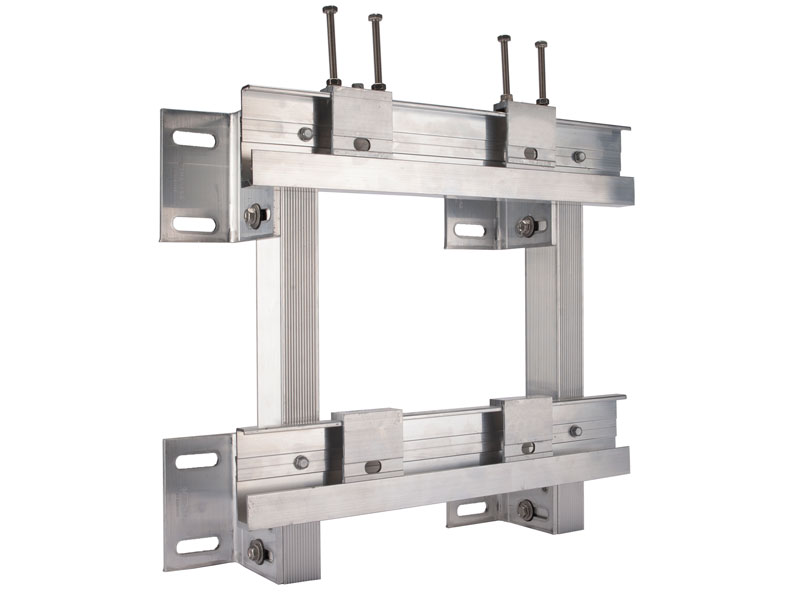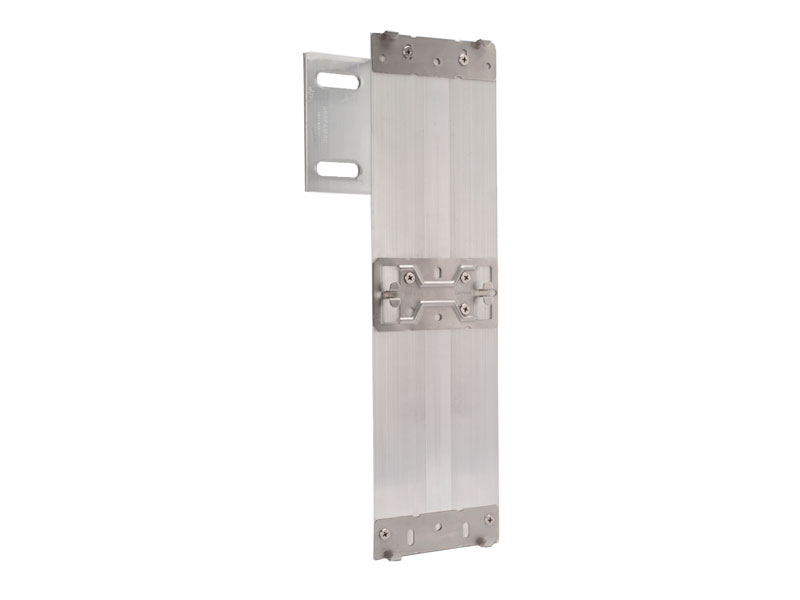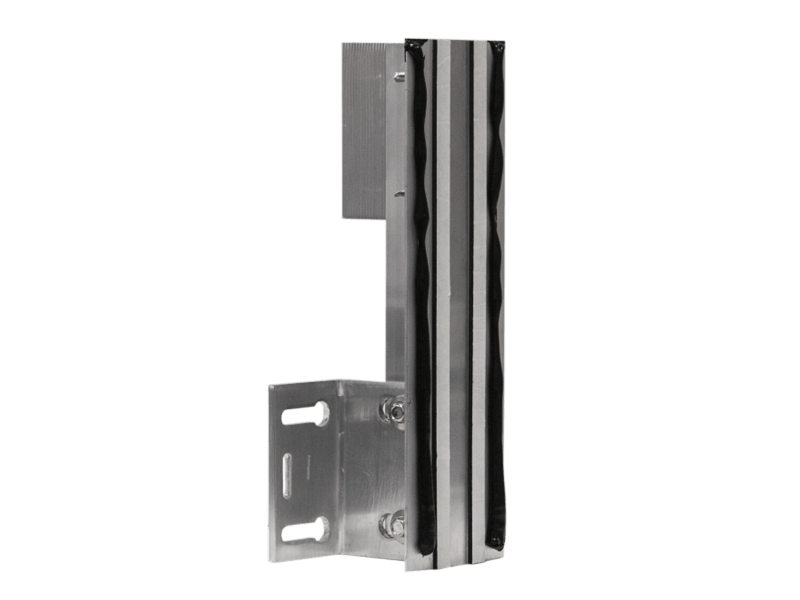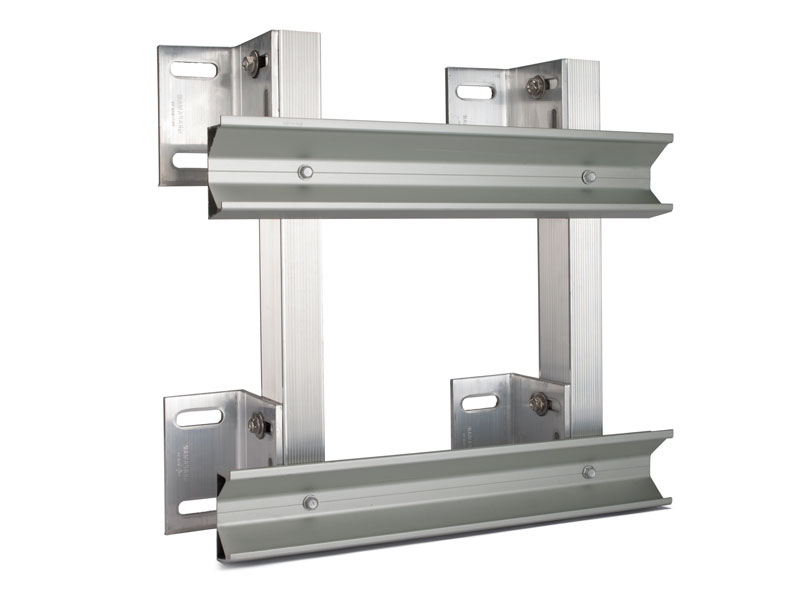
The GRAPAMAR cladding type with reference 1010 is designed to support slabs of porcelanate, porcelain tiles, slates or similar with thicknesses between 7 and 20 mm. for both vertical and horizontal facades. It is completely made on stainless steel with quality AISI 304 and AISI 316, following the regulation AEN/CTN.41-GT4 on claddings for construction. At present, it is the only one existing on the market that allows damaged slabs to be replaced easily.
The advantages that it offers:

Type AE claddings are those which use an improved and lightly expansively mortar of plastic consistency as an element of union between the cladding and the supporting face.
This cladding must be firmly and deeply fixed into a solid base.
They must absorb the charges derived from the weight of the slab and from the pressure and whirls made by the wind.
When being fixed to the pieces of construction that serve them as support, they must not debilitate their transverse section. Every slab will have to be fastened at a minimum of four points minimum and rest on these two supporting claddings and remain held by them and by two retention claddings, facing the charges or efforts that it should support.
The principal elements of this cladding are:

Very simple claddings which consist of a shaped sheet of stainless steel. Depending on the shape we could show a wide range of this type of claddings, although the most usual models are:
cladding of shaped platen that presents a draft in one of its ends, with which it increases its inertia.

Punctual retention and support cladding. It consists of a spiral rod and printing.

The AM cladding is placed directly on the brick or concrete wall or on any rigid-resistant closure. This union will be made by means of a screw-peg for fixation with controllable expanding strength. They are capable of supporting the actions that come from the weight of the slab and from the position that it adopts regarding the supporting face. The harnessing of the slab is carried out by means of a cylindrical pin of stainless steel with an adjusting socket that is introduced in each of the drill holes made on the sides, right in the centre of the thickness of the slab. The adjusting socket is the elastic adapter that controls the tensions between the slab and the spiral support of regulation. This technique is the one that offers major safety.

It is fundamental to adjust the staple once finally fixed onto the supporting face, since the closures do not usually have good planimetry and may provoke a not foreseen adaptation of the staple. Otherwise, it would lead us to a long and bothersome process of rectifications, with the risk of committing defects of planimetry. These claddings allow to correct deviations on X, Y and Z axes without detriment to its load capacity and to immediately load the cladding. They also allow indistinctly to hook the slab both to the base and to the side. In both cases, the low pins are supporting pins and the superior ones are of retention. For the ideal election, it is necessary to abide by the recommendations of load that allow our claddings.

The profiles are the result of a big technological study based on the use of few but very well designed components. It obtains great assembly ease and reaches considerably superior yields compared to other systems on the market, as well as a perfect fixation, facilitating the free deformation of a set as heterogeneous as the materials that shape the cladding of a facade.
The main virtue of this system is that it transmits the efforts directly to the forged (without transmitting them to the closure) and it solves the situations in which unusual separations between facing, support and appeased are needed.

It consists of an substructure which is adjustable in the three directions of the space in order to optimize the planimetry of the facade. This technique offers many less points of claddinging than the traditional ones (therefore diminishing the number of perforations, noise, dust, etc.) for what it very high yields of assembly as well as the optimization of the thermal insulator that becomes continued, covered with panels or projected on the movable closure of the building.
The linking element between profiles is a component of the auxiliary structure that gives them continuity by absorbing the material expansion.

The profile is claddinged to the support by means of an element of intermediate subjection. This component allows to correct problems of planimetry of the base, adapting itself to the most fussy surfaces.
In short, profiles allow a clear distinction of the different stages of the work.
The most important element of this cladding is the fixation of the profile and the cladding.
In addition to this type of staple, another solution that has been adopted in other constructions is the use of our cladding Ref. 1020
and Ref. 1025.